New Patients Accepted (954) 966-6410
A dental crown is a custom restoration that covers the visible portion of a damaged or weakened tooth. It can protect the remaining tooth structure, restore a more functional bite, and recreate the tooth’s natural shape and appearance.
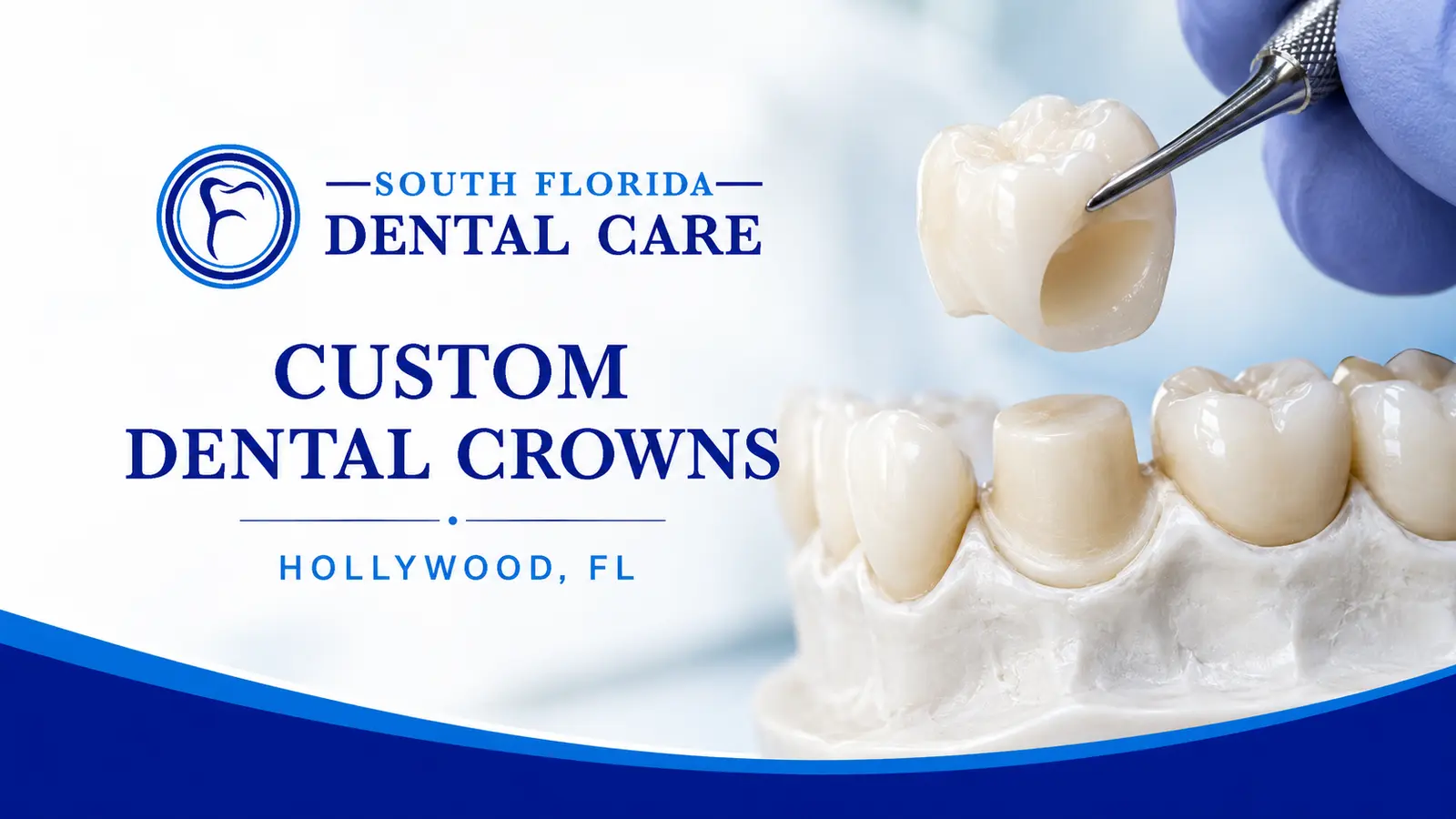
At South Florida Dental Care, we provide custom dental crowns for patients in Hollywood, Pembroke Pines, Hallandale Beach, Aventura, and surrounding communities. Crown treatment is planned according to the condition of the tooth, its position in the mouth, your bite, and the appearance you want to achieve.
Call (954) 966-6410 or request a consultation to have a damaged, weakened, or heavily restored tooth evaluated.
A crown, sometimes called a dental cap, surrounds the portion of a natural tooth that remains above the gumline. Unlike a filling, which repairs a specific area within a tooth, a crown covers the tooth more extensively.
The crown is shaped to restore appropriate contact with neighboring and opposing teeth. When the tooth is visible in the smile, its color, contour, surface texture, and translucency are also considered to ensure the restoration blends naturally with the surrounding teeth.
A crown does not make a compromised tooth indestructible. The underlying tooth, crown margin, gums, and supporting bone still require daily care and professional maintenance.
A dental crown may be recommended to:
Not every damaged tooth requires a crown. The recommendation depends on how much healthy tooth structure remains, the location and depth of the damage, the condition of previous restorations, and the forces placed on the tooth during biting and chewing.
The appropriate restoration should repair the tooth without removing more healthy structure than necessary.
A tooth-colored filling may be sufficient when the damaged or decayed area is limited, and the remaining tooth can support the restoration.
An inlay or onlay may be considered when a tooth needs more coverage than a filling but does not necessarily require a full crown. An onlay can cover one or more weakened chewing surfaces while preserving other portions of the tooth.
A crown may be more appropriate when damage is extensive, several surfaces are compromised, a major portion of the tooth is missing, or the remaining structure needs broader protection.
These treatments are not interchangeable in every situation. Your dentist will explain the condition of the tooth and why a particular restoration is being recommended.
Crown treatment begins with an examination of the tooth, gums, bite, and existing dental work. Dental X-rays or other records may be needed to evaluate decay, previous treatment, the tooth’s roots, and the surrounding bone.
After the tooth is anesthetized, damaged or decayed material is removed. The remaining tooth is shaped to create adequate space and support for the crown. If substantial tooth structure has been lost, a foundation or core buildup may be needed before the crown is made.
An impression or digital record is used to capture the prepared tooth and its relationship to the surrounding teeth. The dentist also records information about tooth color, shape, and bite.
A custom crown may be fabricated by a dental laboratory or through another restorative workflow selected for the case. The treatment schedule depends on the tooth, restoration, material, and fabrication method.
If the final restoration is not placed during the preparation appointment, a temporary crown protects the tooth while the custom crown is fabricated.
Temporary crowns are not as strong as definitive restorations. Avoid chewing especially hard or sticky foods directly on the temporary crown, and contact the office if it becomes loose, fractures, or comes off.
Before placement, the dentist evaluates the crown’s fit, contacts, bite, shape, and appearance. Adjustments may be made before the restoration is bonded or cemented into position.
Your bite should feel comfortable after placement. If the crown feels noticeably high or causes discomfort when chewing, contact the office for evaluation rather than waiting for the bite to adjust on its own.
Receiving a crown does not automatically mean a tooth needs root canal treatment. Many crowned teeth retain healthy living pulp tissue.
A root canal may be necessary when the pulp inside the tooth is infected, irreversibly inflamed, or damaged by deep decay, a crack, trauma, or previous dental treatment. The need for root canal treatment is determined by the condition of the tooth, not simply by whether a crown is planned.
A tooth that has already received root canal treatment may require a crown or another definitive restoration to reduce the risk of further structural damage. The recommendation depends on the tooth’s location and the amount of healthy structure remaining.
Crowns can be made from several materials. There is no single material that is best for every tooth or every patient.
Ceramic materials can reproduce many of the optical characteristics of natural teeth and are frequently used in visible areas. Different ceramics offer different combinations of translucency, strength, and wear resistance.
Zirconia is a ceramic material that may be selected when additional strength is important. Its suitability depends on the tooth’s location, available space, bite forces, and cosmetic requirements.
Porcelain-fused-to-metal crowns combine an internal metal structure with an outer tooth-colored layer. They have a long history of clinical use, although the underlying metal can affect translucency or become more visible near the gumline in some situations.
Metal crowns can provide strength in areas exposed to substantial chewing forces and require different preparation considerations than some ceramic restorations. Their metallic appearance generally limits their use to less visible teeth when appearance is a priority.
Material selection should consider:
A crown placed over a natural tooth and a crown attached to a dental implant may look similar above the gumline, but they are supported differently.
A natural-tooth crown covers and protects an existing prepared tooth. The tooth’s root remains in the jaw and continues to support the restoration.
An implant crown replaces the visible portion of a missing tooth and attaches to a dental implant through an abutment or another restorative connection. Because the natural tooth is absent, implant treatment has different surgical, restorative, and maintenance considerations.
Learn more about planning an implant-supported tooth replacement.
A crown on a visible tooth must do more than cover damage. Its shape, length, contour, shade, translucency, and relationship to the gumline all affect how naturally it blends with the smile.
Existing bonding, fillings, veneers, and neighboring crowns may influence shade selection. If you are also considering professional teeth whitening, whitening is generally completed before a new visible crown is shade-matched because restorative materials will not become lighter afterward.
When several visible teeth require coordinated cosmetic changes, your dentist may discuss crowns alongside cosmetic bonding, porcelain veneers, or another personalized cosmetic dentistry treatment.
A crown’s service life varies. It should not be presented as permanent or guaranteed for a specific number of years.
Longevity can be affected by:
A crown may eventually require repair or replacement, even when it has been well-maintained. The underlying tooth can also develop decay, fracture, or another condition requiring treatment.
Brush a crowned tooth twice daily and clean between it and the neighboring teeth. Plaque can accumulate where the crown meets the natural tooth, making the crown margin an important area to maintain.
Regular dental examinations and professional cleanings allow the dentist to monitor the crown, the supporting tooth, the bite, and the surrounding gums.
Avoid using crowned teeth to open packaging or bite hard non-food objects. If you grind or clench, your dentist may recommend a protective appliance based on your individual risk.
Contact the dental office if you experience:
These symptoms do not always mean the crown must be replaced, but they should be evaluated before the condition becomes more difficult to treat.
Dr. Leonardo Frydman is a prosthodontist with advanced education in restoring and replacing teeth. Prosthodontic training includes treatment involving crowns, bridges, dental implants, dentures, veneers, and more comprehensive restorative care.
Dr. Gabriela Cohen has postgraduate education in operative and cosmetic dentistry and provides comprehensive restorative care with attention to preserving healthy tooth structure.
Learn more about what a prosthodontist does or meet the dentists at South Florida Dental Care.
South Florida Dental Care is located at 4030 Sheridan Street, Suite B, in Hollywood, Florida. We welcome patients from Hollywood, Pembroke Pines, Hallandale Beach, Aventura, and nearby communities.
If you have a damaged, fractured, heavily restored, or root-canal-treated tooth, call (954) 966-6410 or contact South Florida Dental Care to request an evaluation.