New Patients Accepted (954) 966-6410
Dental anxiety can make it difficult to schedule an appointment, remain comfortable during treatment, or complete needed care. Oral conscious sedation uses prescription medication to help selected patients feel calmer and more relaxed during a dental procedure.
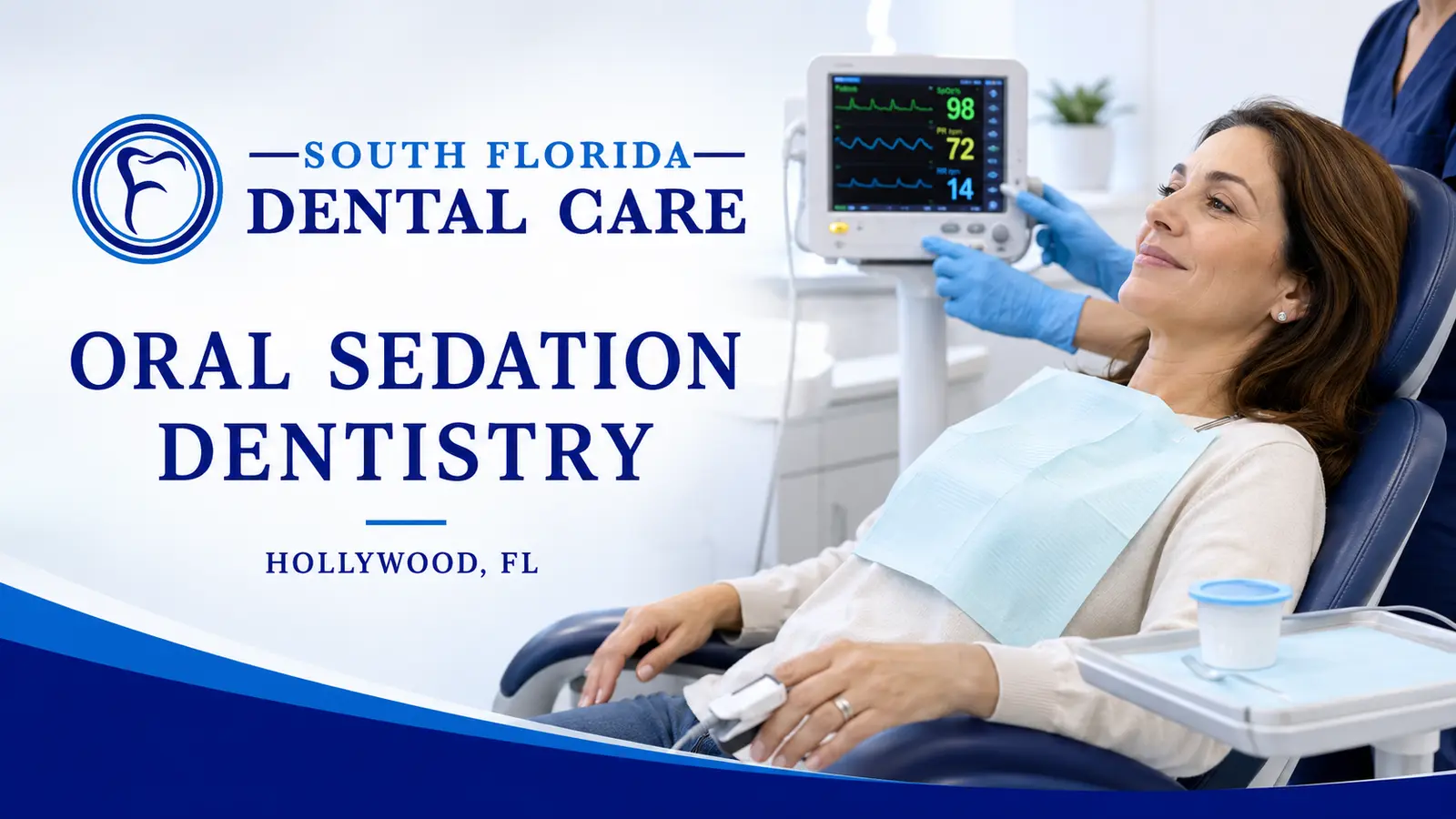
South Florida Dental Care offers oral sedation for appropriate adult patients in Hollywood, Pembroke Pines, Hallandale Beach, Aventura, and surrounding communities. Sedation is considered only after reviewing your health, medications, treatment needs, anxiety level, and ability to follow preparation and recovery instructions.
Call (954) 966-6410 or request a consultation to discuss dental anxiety and whether oral sedation may be appropriate for you.
Oral conscious sedation involves taking prescription medication before dental treatment. The medication is selected and prescribed according to the intended level of sedation, your medical history, and other patient-specific considerations.
The term “conscious” is important. Oral sedation is not the same as general anesthesia. Patients typically remain able to respond purposefully to verbal directions or appropriate stimulation, although they may feel deeply relaxed and drowsy.
Some patients remember little about the appointment, but reduced memory should not be promised. Individual responses to sedative medication vary.
Sedation helps manage anxiety, awareness, and comfort. It does not necessarily prevent pain by itself.
Local anesthesia may still be required to numb the treatment area. Patients who are afraid of injections should discuss that concern openly so the dental team can explain when a local anesthetic is needed and how it will be administered.
Oral sedation can make the overall experience more manageable, but it does not guarantee that no injections will be used or that the patient will be completely unaware of treatment.
Oral sedation may be considered for patients who experience:
Sedation is only one part of anxiety management. Clear communication, shorter appointments, agreed-upon signals, explanation of each step, and a gradual treatment plan may also help.
The American Dental Association encourages patients to tell the dental office about their anxiety when scheduling and again when arriving for treatment. Learn more from the ADA’s dental anxiety guidance.
Oral sedation is not appropriate for every patient or every procedure. Suitability may be affected by:
This list is not complete. A consultation and medical review are necessary before sedation can be prescribed.
Before oral sedation, provide complete and accurate information about:
Do not omit a medication or health condition because it seems unrelated to dentistry. Sedative medications can interact with other drugs and affect breathing, coordination, judgment, and recovery.
Your dentist may need additional medical information or consultation with another healthcare provider before determining whether sedation can proceed.
The office will provide instructions based on the medication, planned procedure, and your health. Follow those instructions exactly rather than relying on general advice found online.
Instructions may address:
Do not change a prescribed medical medication unless instructed by the appropriate healthcare professional.
Avoid alcohol, cannabis, recreational drugs, and any unapproved sedating product before or after the appointment. Combining substances can produce unpredictable and potentially dangerous effects.
Patients receiving oral sedation must arrange for a responsible adult to bring them to the office, remain available as instructed, and drive them home afterward.
A taxi or rideshare driver generally does not satisfy the escort requirement because the patient needs a responsible person who understands the recovery instructions and can assist after the appointment.
Patients should not drive, operate machinery, return to work, drink alcohol, make important decisions, or perform activities requiring coordination or judgment until the medication’s effects have resolved and the dentist’s restrictions have ended.
The dental team confirms that the preparation instructions were followed and reassesses the patient before treatment begins. Vital signs and the patient’s level of responsiveness are monitored in accordance with the intended level of sedation and applicable clinical requirements.
The patient may feel:
The dentist may also use local anesthesia to numb the treatment area. The dental procedure itself is performed according to the treatment plan; sedation does not change the clinical steps required to complete quality care.
Oral conscious sedation should not be described as putting every patient to sleep. A deeply relaxed patient may close their eyes or appear to sleep, but conscious sedation is different from general anesthesia.
The intended response is for the patient to remain capable of purposeful response when appropriately prompted. The exact depth of sedation can vary according to the medication, dose, individual response, health, and whether other sedating substances are involved.
Because sedation exists on a continuum, patient screening, appropriate dosing, monitoring, and emergency preparedness are important parts of care.
General anesthesia produces a controlled loss of consciousness and requires a different level of training, equipment, airway management, monitoring, and recovery care.
Oral conscious sedation uses medication intended to reduce anxiety while maintaining an appropriate level of responsiveness. It should not be marketed as a simpler form of general anesthesia or as guaranteed “sleep dentistry.”
If a patient’s health, anxiety, procedure, or treatment needs require a different level of sedation or anesthesia, the dentist may recommend an alternative approach or a referral to an appropriately equipped provider.
All sedative medications have potential risks and side effects. Depending on the medication and patient, these may include:
Your dentist will discuss material risks, expected benefits, alternatives, and required precautions before obtaining informed consent.
The effects of oral sedative medication can persist after the dental procedure. The patient must be discharged to the responsible adult escort and follow all written recovery instructions.
After treatment:
The dentist will explain when normal activities can be resumed. Recovery time varies and should not be assumed based on another patient’s experience.
Oral sedation may be considered for various dental treatments, but its suitability depends on the patient, procedure, expected treatment time, and intended level of sedation.
It may be discussed in connection with selected restorative or prosthodontic treatment such as dental crowns, dental implant treatment, or a more involved full-mouth rehabilitation.
Not every patient needs sedation, and not every procedure should be combined into one long appointment simply because sedation is available. Treatment should remain based on clinical need, patient safety, and the ability to provide appropriate care.
Review the practice’s complete range of dental care services.
Patients who are not candidates for oral sedation—or who prefer not to use it—may still benefit from:
The goal is not merely to complete a procedure. It is to create a treatment approach that the patient can understand, tolerate, and maintain over time.
A separate evaluation may be needed before a sedation appointment can be scheduled. Bring an accurate list of medications and be prepared to discuss your medical history, previous sedation experiences, and specific dental concerns.
South Florida Dental Care is located at 4030 Sheridan Street, Suite B, in Hollywood, Florida. We welcome patients from Hollywood, Pembroke Pines, Hallandale Beach, Aventura, and nearby communities.
Call (954) 966-6410 or contact South Florida Dental Care to request a consultation and discuss whether oral conscious sedation may be appropriate for your treatment.