New Patients Accepted (954) 966-6410
A damaged back tooth does not always need a full dental crown. When a cavity, fracture, or failing filling is too extensive for a routine filling but enough strong tooth structure remains, a custom porcelain inlay, onlay, or overlay may provide a more conservative solution.
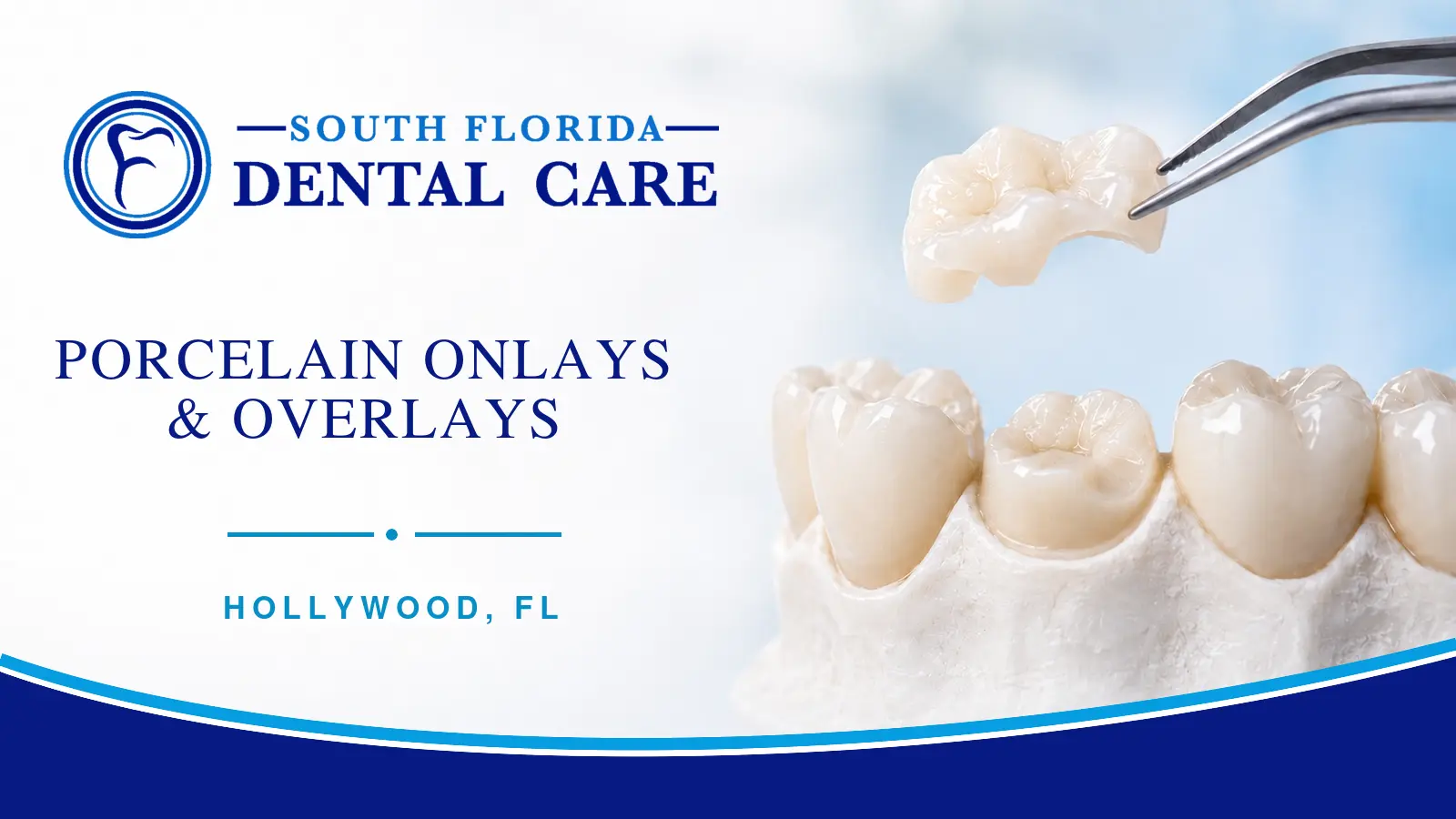
These restorations are designed to rebuild the damaged portion of the tooth, protect weakened chewing surfaces, and fit comfortably within the bite. Because porcelain can be shaped and shaded to coordinate with natural enamel, the finished restoration can provide both functional support and a tooth-colored appearance.
If you have a cracked molar, a large old filling, or discomfort when chewing, call South Florida Dental Care at (954) 966-6410 or request an appointment online.
Our dentists can determine whether your tooth needs a filling, an inlay, an onlay, an overlay, or a dental crown.
Inlays, onlays, and overlays are custom restorations used primarily to repair premolars and molars. They are often described as indirect restorations because they are created from a detailed impression or digital record of the prepared tooth and then bonded into place.
The difference between them is based primarily on how much of the tooth they cover:
The terms may overlap in everyday dental use. The important issue is not the name assigned to the restoration, but how much healthy tooth remains and how much coverage is required to support it.
A porcelain inlay, onlay, or overlay may be considered when a back tooth has sustained more damage than a conventional filling can predictably repair. Possible reasons include:
Not every damaged tooth is a candidate. Before recommending an onlay, our dentists examine the remaining enamel, the depth and location of the damage, the condition of the dental nerve, and the forces placed on the tooth during biting and chewing.
If the damage is limited, one of our tooth-colored restorations may be sufficient. If the tooth is severely weakened, fractured below the gumline, or missing too much structure, a crown or another restorative treatment may provide more predictable support.
The correct restoration should provide enough protection without unnecessarily removing healthy tooth structure. That balance is different for every tooth.
A filling is placed and shaped directly in the tooth. It is generally most appropriate when the damaged area is relatively limited, and the surrounding tooth can adequately support the restoration.
An inlay fills a damaged area within the chewing surface without covering the tooth’s cusps. It may be considered when a direct filling would be too large, but the cusps remain healthy and well supported.
An onlay or overlay covers one or more weakened cusps in addition to repairing the central portion of the tooth. This additional coverage can help distribute chewing forces across a larger area.
A crown surrounds nearly the entire visible portion of the prepared tooth. It is generally used when the remaining tooth requires more comprehensive reinforcement than an inlay or onlay can provide.
Choosing the smallest restoration is not necessarily the most conservative choice if it leaves a weakened tooth at risk of breaking. Likewise, a full crown may not be necessary when adequate enamel remains to support a bonded partial restoration. Careful diagnosis determines which option is appropriate.
Porcelain and other dental ceramics can be fabricated with detailed contours that reproduce the grooves and anatomy of a natural chewing surface. When properly selected for the tooth, potential advantages include:
The American Dental Association explains that available restorative materials include tooth-colored composites, as well as ceramic, zirconia, and gold inlays or onlays. Material selection should be based on the tooth, the bite, the location of the restoration and the patient’s clinical needs. Patients can review additional information through the ADA’s MouthHealthy restorative-material resource.
An onlay cannot repair every damaged tooth. A fracture may extend farther beneath the gumline than initially visible, or decay may leave too little healthy enamel to retain a partial restoration. Teeth with nerve involvement may require additional treatment before the final restoration is placed.
Bite forces also matter. Patients who grind or clench their teeth may place substantial pressure on porcelain and natural enamel. In these cases, the restoration must be planned with the complete bite in mind, and a protective nightguard may be recommended after treatment.
Porcelain itself cannot develop decay, but the natural tooth can still decay where the restoration meets the enamel. Good home care and professional examinations remain important.
Your dentist examines the tooth and may take dental images to determine the depth of the damage and the condition of the surrounding structures. The tooth is also evaluated within the bite. We explain the recommended restoration, alternative treatments, and any limitations identified during the examination.
The tooth is numbed, and the damaged or decayed material is removed. Any failing filling is also removed so the underlying tooth can be inspected. The preparation is shaped to preserve sound structure while providing space and support for the restoration.
An impression or digital record captures the prepared tooth, adjacent teeth, and opposing bite. This information is used to design the inlay, onlay, or overlay with the appropriate fit, contours, and contact areas.
Depending on the fabrication process used for the case, a temporary restoration may be placed while the final porcelain restoration is completed. Patients should avoid chewing especially hard or sticky foods on a temporary restoration.
At the placement visit, the dentist evaluates the restoration’s fit, shade, contacts, and relationship with the opposing teeth. Once these details are confirmed, the restoration is securely bonded to the tooth. The bite is then checked and adjusted as necessary.
Dr. Leonardo Frydman is a prosthodontist with advanced education in restoring and replacing teeth. Prosthodontic treatment planning considers not only the damaged portion of a tooth, but also how the restoration will function with the adjacent teeth and the patient’s complete bite.
The American College of Prosthodontists describes prosthodontists as specialists with advanced training in restoring and replacing teeth and in coordinating treatment for complex dental conditions.
This perspective can be especially valuable when a patient has several large restorations, extensive wear, missing teeth, or a history of repeated fractures. In these situations, an individual onlay should be planned as part of the patient’s broader oral health rather than treated as an isolated repair.
Patients with more extensive functional concerns may benefit from a coordinated evaluation for full mouth rehabilitation. You can also learn more about Dr. Frydman and Dr. Gabriela Cohen on our Meet the Doctors page.
Care for the restored tooth with twice-daily brushing, fluoride toothpaste, and daily cleaning between the teeth. Pay particular attention to the area where the porcelain meets the natural tooth.
Routine examinations allow the dentist to evaluate the restoration, the surrounding enamel, the gum tissue, and the bite. Professional cleanings help remove plaque and hardened deposits from areas that may be difficult to reach at home.
Avoid chewing ice and using your teeth to open packaging or bite objects. Tell your dentist if you grind your teeth, clench your jaw, or notice new wear. Contact the office if the restoration feels loose, the bite suddenly feels uneven, or the tooth becomes persistently sensitive.
No. A crown covers nearly the entire visible portion of a prepared tooth. An onlay covers the damaged chewing surface and one or more cusps while leaving other healthy portions of the tooth uncovered.
Generally, an overlay covers a broader portion of the chewing surface and may extend over most or all of the cusps. Terminology can vary, so the treatment recommendation should describe exactly which areas of the tooth will be covered.
There is no single lifespan that applies to every restoration. Longevity depends on the remaining tooth structure, the location of the restoration, bite forces, oral hygiene, diet, grinding or clenching habits, and regular professional care.
Sometimes. If a large metal filling is failing or no longer supports the surrounding tooth, an onlay may be considered after the filling is removed and the tooth is evaluated. A crown may be necessary if the remaining structure is too weak or extensively fractured.
Porcelain can be selected and characterized to coordinate with the surrounding enamel. The goal is to create a restoration that blends naturally while reproducing the contours needed for comfortable chewing.
The tooth is typically numbed during preparation. Some temporary sensitivity may occur after dental treatment, but it should improve. Contact the office if discomfort is significant, persists, or occurs because the bite feels uneven.
If you have a cracked molar, a failing filling, or a back tooth that needs more support than a conventional filling can provide, our dentists can determine whether a porcelain inlay, onlay, overlay, or crown is appropriate.
South Florida Dental Care is located at 4030 Sheridan Street, Suite B, Hollywood, FL 33021. We welcome patients from Hollywood, Emerald Hills, Pembroke Pines, Hallandale Beach, Aventura, and surrounding Broward County communities.
Call (954) 966-6410 or request a dental appointment online to schedule your evaluation.