New Patients Accepted (954) 966-6410
A prosthodontist is a dentist who has completed advanced specialty education focused on diagnosing, restoring, and replacing damaged or missing teeth. Prosthodontists consider how the teeth, gums, bite, appearance, and existing dental work function together when developing a treatment plan.
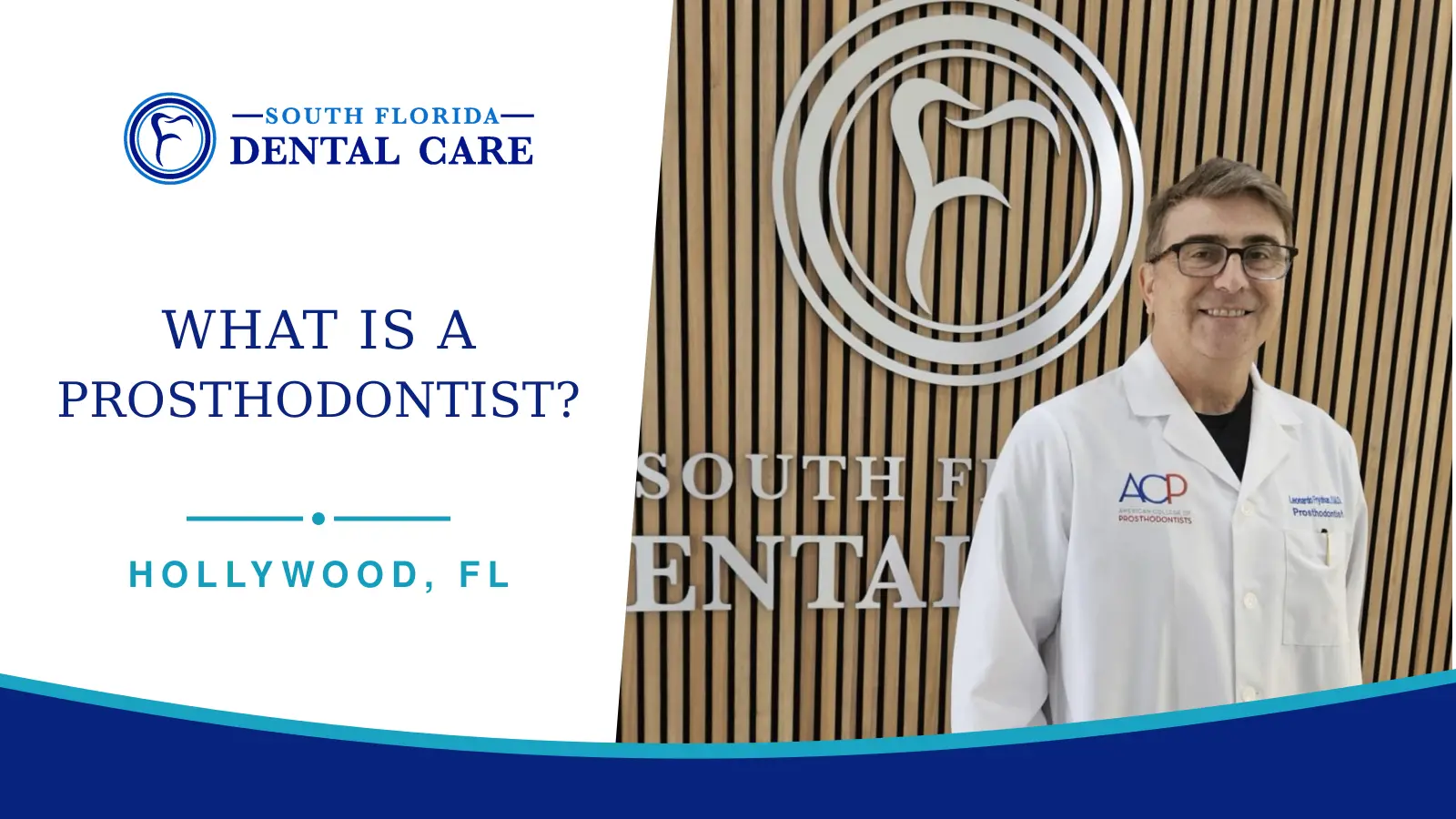
At South Florida Dental Care, Dr. Leonardo Frydman provides prosthodontic care for patients with missing teeth, damaged teeth, aging dental work, cosmetic concerns, and more complex restorative needs.
Patients do not need to know which procedure they require before scheduling an appointment. The first step is an evaluation of the condition, followed by a discussion of the reasonable treatment options.
If you would like to meet with a prosthodontist in Hollywood, Florida, call South Florida Dental Care at (954) 966-6410 or request an appointment online.
Prosthodontics is a recognized dental specialty involving the diagnosis, treatment planning, rehabilitation, and maintenance of oral health, function, comfort, and appearance for patients with missing or deficient teeth and related oral structures.
In practical terms, prosthodontists help patients preserve damaged teeth when possible and replace teeth that are missing or cannot be predictably restored. They also plan how multiple restorations will work together within the patient’s bite and smile.
According to the National Commission on Recognition of Dental Specialties and Certifying Boards, prosthodontics is one of 12 currently recognized dental specialties.
Prosthodontic treatment may range from restoring a single damaged tooth to coordinating care across much of the mouth. The extent of treatment depends on the patient’s condition rather than the name of the specialty.
After completing dental school, a prosthodontist completes at least three additional years of advanced education in an accredited graduate prosthodontics program. This specialty training includes diagnosis, comprehensive treatment planning, dental materials, restorative procedures, tooth replacement, bite relationships, dental laboratory principles, and the coordination of complex care.
The American College of Prosthodontists explains that this education prepares prosthodontists to manage dental and facial conditions involving the restoration of damaged teeth and the replacement of missing teeth and oral structures.
Training commonly includes:
This additional education is particularly useful when several dental conditions must be evaluated together or when different treatment options involve important structural, functional, and cosmetic considerations.
A prosthodontic evaluation may be helpful when you have concerns about damaged teeth, missing teeth, aging restorations, dentures, dental implants, or how multiple teeth work together.
Reasons to consult a prosthodontist may include:
Not every patient who visits a prosthodontist requires extensive treatment. A prosthodontist may determine that a relatively limited restoration is appropriate, that an existing restoration can continue to be monitored, or that another type of dental care should be completed first.
General dentists diagnose and treat a broad range of oral health conditions. They provide preventive care and may also perform restorative, cosmetic, and tooth-replacement procedures.
A prosthodontist is a dentist who has completed additional accredited specialty education in the restoration and replacement of teeth. The distinction is based on advanced training, not on the assumption that only a prosthodontist can provide restorative treatment.
General dentists and prosthodontists often work together. A general dentist may refer a patient for a prosthodontic evaluation when the condition is unusually complex, several treatments need to be coordinated, or advanced tooth-replacement planning would be helpful. A prosthodontist may also coordinate care with periodontists, oral surgeons, endodontists, orthodontists, dental laboratory technicians, and other professionals.
At South Florida Dental Care, Dr. Frydman and Dr. Gabriela Cohen work within the same practice, allowing treatment to be planned according to the patient’s needs rather than separated into unrelated procedures.
Prosthodontics is not one procedure. It encompasses several ways to restore damaged teeth, replace missing teeth, and improve dental function and appearance.
A damaged tooth may be treated with a tooth-colored restoration, a porcelain onlay or overlay, or a custom dental crown. The appropriate restoration depends on how much healthy tooth structure remains, where the damage is located, and how much force the tooth must withstand.
A prosthodontist evaluates whether a tooth can be predictably preserved and what level of coverage may provide sufficient protection without removing more healthy structure than necessary.
A fixed dental bridge replaces one or more missing teeth with a restoration supported by neighboring teeth or dental implants. Bridge design depends on the location of the missing tooth, the condition of the supporting teeth, the bite, and the patient’s maintenance needs.
Dental implants can support individual crowns, bridges, or certain types of dentures. Implant treatment requires careful planning of both the implant placed in the bone and the restoration attached to it.
Implants are not automatically the best option for every missing tooth. Bone support, gum health, medical considerations, neighboring teeth, treatment time, maintenance, and patient preferences must all be evaluated.
Full and partial dentures can replace several teeth or an entire arch. Prosthodontic planning considers fit, support, stability, appearance, speech, chewing, and the relationship between the upper and lower teeth.
A prosthodontist can also evaluate an older denture that has become uncomfortable, unstable, worn, or difficult to use.
When several teeth are worn, damaged, failing, or missing, treatment may need to be coordinated as part of a full-mouth rehabilitation. This is a treatment-planning process, not one standard procedure.
The plan may combine periodontal treatment, fillings, onlays, crowns, bridges, dentures, dental implants, and cosmetic procedures. It should include only the care appropriate for the patient and does not mean that every tooth automatically needs a crown.
Prosthodontic training includes the appearance of teeth and restorations as well as their function. Cosmetic dentistry may address tooth color, shape, proportion, spacing, visible wear, and older restorations that no longer blend naturally.
Possible treatments include cosmetic bonding, porcelain veneers, professional teeth whitening, or carefully designed porcelain restorations.
Appearance should be considered alongside gum health, remaining tooth structure, bite forces, and long-term maintenance, rather than treated as an isolated concern.
Restoring an individual tooth without considering the rest of the mouth may be reasonable in a straightforward case. When several teeth are involved, however, the order and relationship of treatment become more important.
For example:
Comprehensive planning helps establish which conditions should be treated first, which teeth can be maintained, how missing teeth may be replaced, and how the completed restorations will function together.
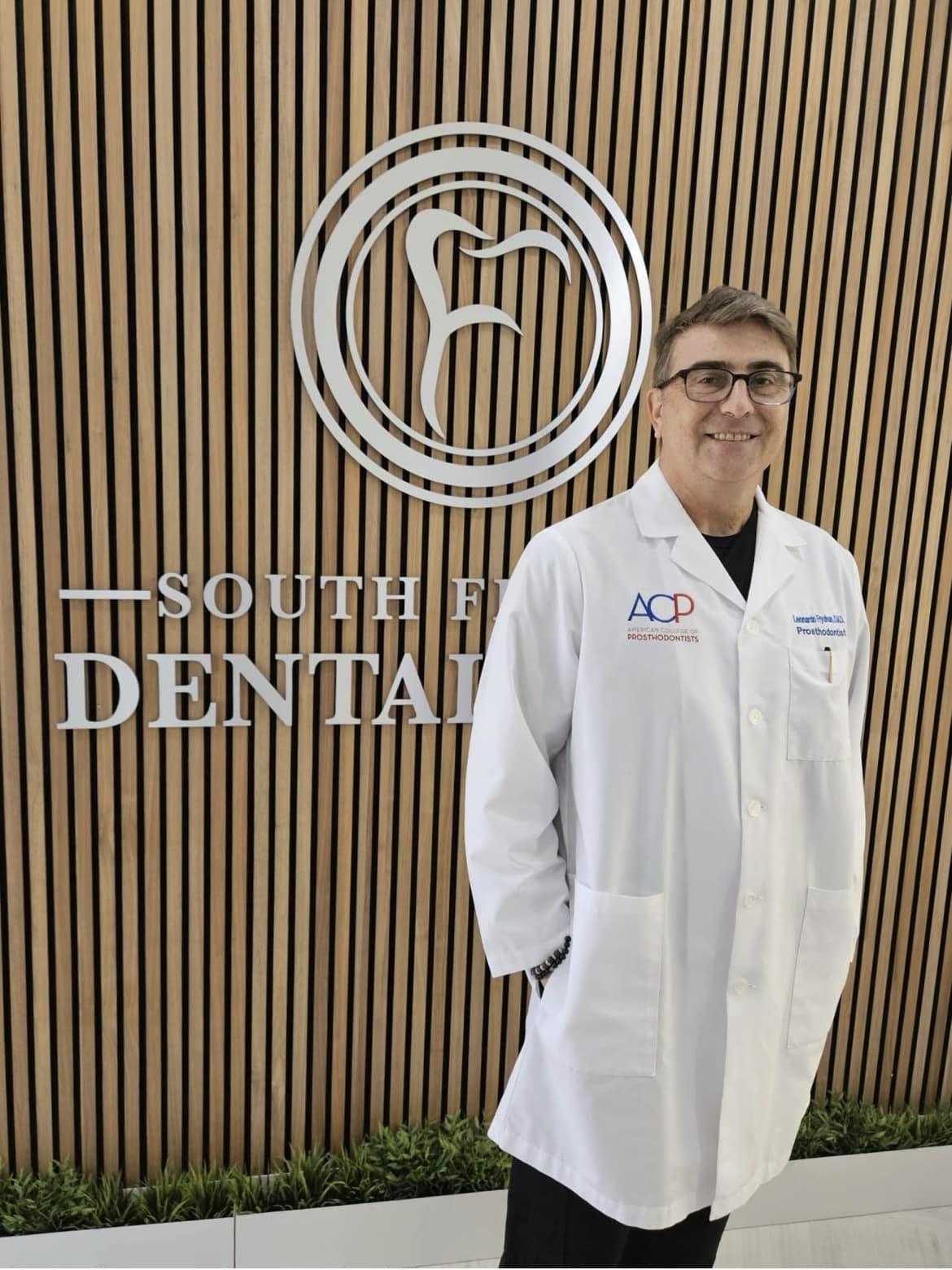
Dr. Leonardo Frydman, DMD, CAGS, completed his initial dental education at Universidad Intercontinental in Mexico City in 1989. In 1992, he completed postgraduate education in prosthodontics at Boston University.
After his specialty education, Dr. Frydman served as a clinical assistant professor in the Advanced Education in General Dentistry Department at the Boston University Goldman School of Dentistry. He later moved to South Florida and joined the practice that became South Florida Dental Care.
His areas of care include dental implants, crowns, bridges, dentures, cosmetic dentistry, full mouth rehabilitation, complex restorative treatment planning, and the evaluation and replacement of aging dental work.
Dr. Frydman develops recommendations according to the patient’s oral health, existing restorations, bite, priorities, and long-term needs. When more than one reasonable option is available, patients should understand the advantages, limitations, process, and maintenance requirements associated with each choice.
Your first visit begins with a conversation about your concerns, dental history, previous treatment, current symptoms, and what you hope to accomplish.
Depending on the reason for the visit, the evaluation may include:
Complex treatment may require additional records or a separate planning visit. This allows the available information to be reviewed before a final recommendation is made.
Before proceeding, patients should understand what condition has been identified, why treatment is recommended, what reasonable alternatives exist, how the treatment will be completed, and what continuing care will be required.
Yes. A prosthodontist first completes dental school and then completes at least three additional years of accredited graduate specialty education focused on restoring and replacing teeth and related oral structures.
A referral is not generally required to request an appointment at South Florida Dental Care. Patients may contact the office directly if they have concerns about missing teeth, damaged teeth, dentures, dental implants, older restorations, or complex treatment needs.
No. Prosthodontists treat both limited and complex restorative conditions. A patient may need help with one crown, bridge, implant restoration, or denture, while another may require treatment involving several areas of the mouth.
No. Prosthodontics is a formally recognized dental specialty requiring additional accredited education after dental school. Cosmetic dentistry describes care intended to improve dental appearance but is not the same type of recognized specialty designation. Prosthodontic training includes both the appearance and function of restorations.
A prosthodontist can evaluate aging crowns, bridges, dentures, implant restorations, fillings, and other dental work. Whether a restoration can be repaired, should be replaced, or can continue to be monitored depends on its condition and the health of the supporting teeth and tissues.
No. An evaluation does not commit a patient to treatment, and extensive care should not be recommended solely because a patient consulted a specialist. The purpose of the examination is to diagnose the condition and explain the reasonable options.
If you have missing teeth, damaged teeth, uncomfortable dentures, aging dental work, or concerns requiring coordinated restorative care, Dr. Leonardo Frydman can evaluate your condition and explain which options may be appropriate.
South Florida Dental Care is located at 4030 Sheridan Street, Suite B, Hollywood, FL 33021. We welcome patients from Hollywood, Emerald Hills, Pembroke Pines, Hallandale Beach, Aventura, and surrounding communities.
Call (954) 966-6410 or request an appointment with Dr. Frydman online.