New Patients Accepted (954) 966-6410
Dental implants can replace one missing tooth, support a bridge when several teeth are missing, or provide additional stability for a denture. Unlike a traditional bridge or removable denture, an implant is supported by the jawbone and does not rely exclusively on neighboring teeth or the gums.
At South Florida Dental Care, implant treatment is planned according to the number and location of missing teeth, the condition of your gums and jawbone, your bite, medical history, existing dental work, and long-term goals. Our Hollywood dental team will explain whether an implant is appropriate and how it compares with other tooth-replacement options.
Call (954) 966-6410 or request a dental implant consultation to discuss your options.
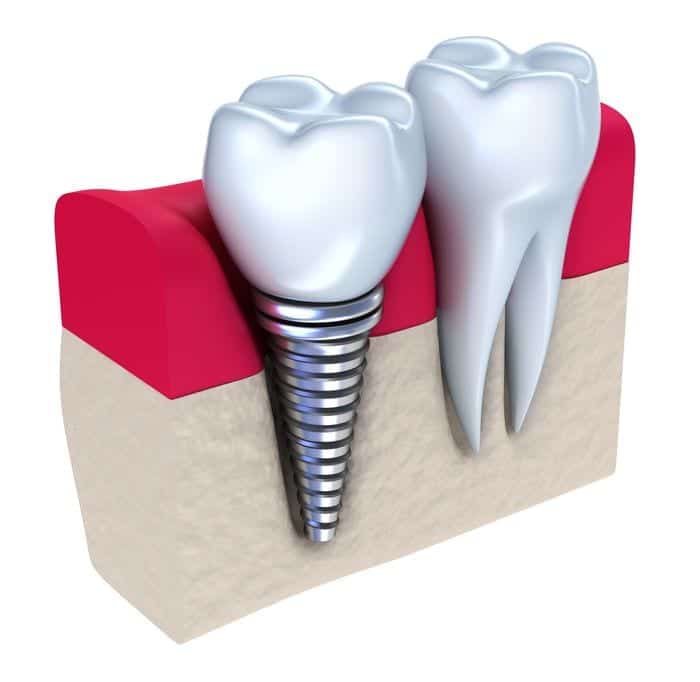
A dental implant is a small post placed in the jawbone to support a replacement tooth or dental prosthesis. Most contemporary implants are made from titanium or another biocompatible material.
It is helpful to understand that the visible replacement tooth is not the implant itself. A single-tooth implant restoration normally has three components:
When several or all teeth are missing, implants may support a fixed bridge, removable overdenture, or other full-arch restoration.
The American Dental Association’s MouthHealthy resource provides additional information about implant components and the healing process.
A single implant and custom crown can replace one missing tooth without requiring crowns on the adjacent teeth. This may be particularly valuable when the neighboring teeth are healthy and would not otherwise require restoration.
The final crown is designed according to the available space, gum contours, neighboring teeth, bite forces, and visibility within the smile.
Explore our information about:
When several neighboring teeth are missing, implants may support a fixed bridge. Because the bridge is supported by implants, it may not be necessary to place one implant for every missing tooth.
The appropriate number and position of implants depend on the location and length of the space, available bone, bite forces, and design of the final restoration.
Patients missing all or most upper or lower teeth may be candidates for an implant-supported or implant-retained denture. Implants can improve stability and reduce movement compared with a conventional removable denture.
Depending on the patient’s anatomy and goals, the final teeth may be removable by the patient or fixed in place and removable only by a dental professional.
Learn more about:
Dental implants have several potential advantages, but their suitability depends on the individual patient and treatment plan.
Potential benefits include:
Implants do not completely prevent future bone changes, and they are not immune to infection, inflammation, mechanical wear, or failure. Long-term success depends on proper planning, healthy tissues, effective home care, appropriate bite management, and regular professional maintenance.
Age alone does not determine whether someone is a candidate for implants. General health, oral health, available bone, healing capacity, and ability to maintain the restoration are often more important.
Your evaluation may consider:
Some health conditions or risk factors do not automatically rule out implant treatment, but they may affect planning, healing, risks, or prognosis. Your dentist may request additional medical information or communicate with your physician when appropriate.
A dental implant requires adequate bone for support and healthy gum tissue around the final restoration. If bone has been lost after an extraction or because of periodontal disease, grafting may be considered before or during implant placement.
Bone grafting is not required in every case. Whether it is appropriate depends on the location and extent of the deficiency, the proposed implant position, and the design of the final restoration.
Active gum disease should also be addressed before implant treatment. Patients with a history of periodontitis may still be candidates, but they require careful evaluation and consistent maintenance because they may face an increased risk of inflammation and bone loss around implants.
Learn more about maintaining your periodontal health.
Implant treatment usually involves several phases. The exact sequence and timeline depend on whether a tooth must be removed, whether grafting is needed, the number of implants, the healing response, and the type of final restoration.
Your dentist reviews your dental and medical history and evaluates your teeth, gums, bite, and missing-tooth area. Dental X-rays and, when appropriate, three-dimensional imaging may be used to assess bone and surrounding anatomical structures.
The final tooth or prosthesis should be considered before selecting the implant position. Implant placement must support a restoration that fits the available space, functions with the bite, can be cleaned, and looks appropriate within the smile.
Some patients require an extraction, treatment of gum disease, bone grafting, or other preliminary care. A temporary tooth or denture may be discussed when appropriate, particularly when a visible tooth is being replaced.
The implant is surgically placed in the planned position. A local anesthetic is normally used. Post-treatment instructions may include temporary dietary changes, oral-hygiene guidance, medication instructions, and activity limitations.
During healing, bone forms a close connection with the implant surface in a process called osseointegration. This process usually takes time and varies according to the implant site, bone quality, treatment performed, health factors, and individual healing response.
After the implant has achieved adequate stability, an abutment and a final crown, bridge, or denture are fabricated. The restoration is evaluated for fit, bite, appearance, and access for cleaning.
Some patients may qualify for a different or accelerated sequence, but immediate placement or immediate teeth are not appropriate for every situation.
Implants and traditional bridges can both replace a missing tooth, but they use different forms of support.
Neither option is automatically better for every patient. Read more about dental bridges and the factors involved in choosing between a bridge and an implant.
A conventional denture rests on the gums and is removable. An implant-retained or implant-supported denture connects to implants for additional stability.
Implants may reduce movement and improve confidence during chewing and speaking, but implant treatment involves surgery, additional treatment time, higher initial cost, and ongoing maintenance of both the implants and prosthesis.
A conventional denture may remain appropriate for patients who prefer a nonsurgical approach or are not candidates for implant treatment. The right choice depends on anatomy, health, goals, dexterity, maintenance ability, and financial considerations.
Implant treatment is not only about placing a post in the jaw. The position of the implant must support a final tooth or prosthesis that functions properly, fits within the available space, complements the smile, and can be maintained.
Dr. Leonardo Frydman is a prosthodontist with advanced education in restoring and replacing teeth. His training includes treatment planning for implant restorations, crowns, bridges, dentures, and more complex rehabilitation.
Prosthodontic planning can be especially valuable when several teeth are missing, existing dental work must be coordinated with implants, the bite is complex, or the final restoration involves an entire arch.
Learn more about what a prosthodontist does and meet our Hollywood dentists.
There are multiple implant manufacturers, sizes, surface designs, connections, and restorative components. The appropriate system is selected according to clinical needs, available bone, restoration design, component availability, and the dentist’s treatment plan—not simply because one implant brand is universally best.
Learn more about dental implant systems and how implants function as substitutes for missing tooth roots.
Dental implants have a strong record of clinical use, but no surgical or restorative treatment is risk-free or guaranteed to last for life.
Potential complications may include:
Your individual risks, alternatives, and expected prognosis should be discussed after a clinical evaluation.
Dental implants cannot develop cavities, but plaque and inflammation can affect the surrounding gums and bone. Implant crowns, bridges, and dentures also contain components that may wear or require maintenance over time.
To care for implant restorations:
Your maintenance schedule should be based on your oral health, periodontal history, restoration design, dexterity, and risk factors.
Treatment time varies. Some patients need only implant placement, healing, and a final crown. Others require an extraction, bone grafting, periodontal treatment, or a more complex prosthesis. The complete process may take several months, but only an examination and treatment plan can provide a meaningful estimate.
A local anesthetic is used during implant placement. Patients may experience swelling, soreness, bruising, or temporary dietary limitations afterward. The expected recovery and pain-management plan depend on the procedure performed and the individual patient.
Implants can function for many years, but they should not be presented as permanent or guaranteed for life. Longevity depends on health, bone and gum stability, oral hygiene, tobacco use, bite forces, implant position, restoration design, and professional
maintenance. The crown, bridge, or denture attached to the implants may require repair or replacement even when the implants remain stable.
Smoking and other nicotine use can interfere with healing and increase the risk of implant complications. Tobacco use does not automatically make treatment impossible in every case, but it should be discussed honestly during the evaluation.
Cost depends on the number of implants, type of restoration, imaging, extractions, grafting, temporary teeth, laboratory work, and whether other treatment is required. A meaningful estimate can only be prepared after the complete treatment plan is determined.
If you are missing one tooth, several teeth, or an entire arch, South Florida Dental Care can help you compare dental implants with bridges, partial dentures, and conventional or implant-supported dentures.
Our office is located at 4030 Sheridan Street, Suite B, in Hollywood, Florida. We welcome patients from Hollywood, Pembroke Pines, Hallandale Beach, Aventura, and surrounding communities.
Call (954) 966-6410 or contact South Florida Dental Care to request your dental implant consultation.