New Patients Accepted (954) 966-6410
Tooth-colored restorations repair areas affected by decay, fractures, wear, or failing dental work while blending more naturally with the surrounding tooth. Composite resin is commonly used for fillings because its shade and contour can be customized for both visible and back teeth.
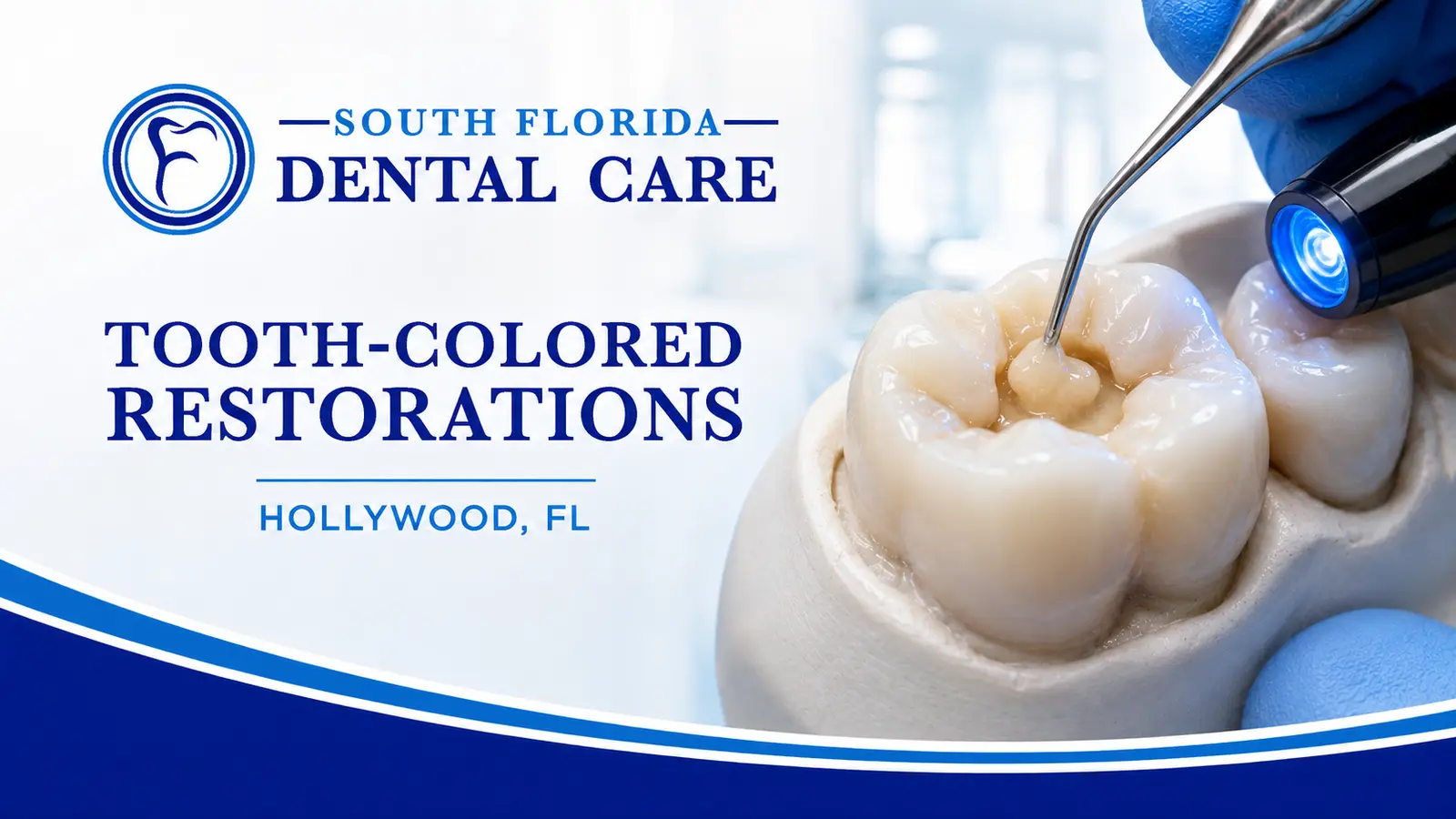
At South Florida Dental Care, we provide tooth-colored restorations for patients in Hollywood, Pembroke Pines, Hallandale Beach, Aventura, and surrounding communities. The appropriate restoration depends on the location and extent of the damage, the amount of healthy tooth structure remaining, and the forces placed on the tooth.
Call (954) 966-6410 or request an appointment to have a damaged tooth or existing restoration evaluated.
A tooth-colored restoration is made from a material selected to resemble natural tooth structure. Composite resin is commonly used for direct fillings and consists of a resin matrix combined with reinforcing filler particles.
Unlike a restoration fabricated by a dental laboratory, a direct composite filling is shaped and hardened within the tooth during the appointment. An adhesive system helps bond the material to the prepared tooth structure.
Composite resin can be selected in different shades and translucencies. After placement, the restoration is shaped, polished, and adjusted to fit the tooth and not interfere with the bite.
A composite restoration may be appropriate for:
A composite is not appropriate for every defect. A very large filling, substantial fracture, weakened chewing surface, or tooth with limited remaining structure may require broader protection from an inlay, onlay, or crown.
Treatment begins with an examination of the tooth. Dental X-rays may be needed to evaluate decay, existing fillings, the tooth’s pulp, and the surrounding bone.
When treatment proceeds:
The amount of preparation and treatment time depends on the location and size of the restoration, as well as whether an existing filling must be removed first.
Tooth-colored composite restorations offer several potential advantages:
Patients should also understand the limitations:
An existing restoration should be evaluated according to its clinical condition rather than its age, color, or material alone.
Replacement may be appropriate when a filling has:
A restoration that remains intact, functional, and free from surrounding decay may not need replacement. Removing any filling also removes some additional tooth structure, so the expected benefit should justify the treatment.
Dental amalgam is a silver-colored filling material made from a combination of metals, including elemental mercury. Patients sometimes ask whether older amalgam fillings should automatically be removed and replaced with composite resin.
The U.S. Food and Drug Administration does not recommend removing amalgam fillings that are in good condition when there is no decay beneath them unless replacement is considered medically necessary. Removing an intact filling can result in unnecessary loss of healthy tooth structure and temporary exposure to additional mercury vapor during removal.
The FDA has identified certain groups that may be more susceptible to the effects of mercury exposure and recommends discussing non-amalgam alternatives when a new treatment is required. Patients with specific health concerns should discuss them with both their dentist and appropriate medical provider.
Read the FDA’s current patient guidance about dental amalgam fillings.
At South Florida Dental Care, an existing amalgam restoration is evaluated for decay, fractures, leakage, wear, tooth integrity, symptoms, and functional concerns. Replacement should be based on the condition of the tooth and restoration, not a blanket recommendation to remove every silver-colored filling.
The extent of the damage determines how much of the tooth must be restored.
Direct composite fillings repair limited areas of decay or damage and are completed within the tooth during the appointment.
Inlays and onlays are custom restorations that may be considered when a tooth requires more coverage than a filling but does not necessarily need a full crown. An onlay can cover one or more weakened chewing surfaces while preserving other healthy areas.
Dental crowns cover the tooth more extensively and may be recommended when damage, decay, fractures, or previous restorations have substantially weakened the remaining structure.
The most conservative treatment is not always the smallest restoration. A filling that is too large for the remaining tooth may fail or leave the tooth vulnerable to fracture. The goal is to choose the least extensive restoration that can predictably repair and protect the tooth.
Composite fillings and cosmetic dental bonding use related tooth-colored materials, but their primary purposes may differ.
A filling generally replaces structure lost to decay, fracture, or an existing restoration. Cosmetic bonding is commonly used to make a targeted change to the visible shape, edge, spacing, or color of a tooth.
Some procedures serve both restorative and cosmetic purposes. For example, composite resin may repair a chipped front tooth while also recreating its natural contour and appearance.
Patients considering improvements to several visible teeth can review the practice’s broader cosmetic dentistry options.
Composite resin can be selected to blend closely with the surrounding tooth structure, but no restoration should be promised as completely invisible in every lighting condition.
Color matching can be influenced by:
Teeth whitening changes the shade of natural teeth but does not lighten composite fillings. When whitening and a visible restoration are both planned, whitening is generally completed first so the new restoration can be matched to the resulting tooth color.
The tooth and surrounding gum may feel temporarily sensitive after a filling is placed. Sensitivity can vary according to the depth and size of the restoration, the previous condition of the tooth, and individual response.
The bite should feel comfortable after the anesthetic has worn off. Contact the office if the filling feels noticeably high, causes pain when chewing, or creates persistent sensitivity.
Symptoms that increase, continue longer than expected, or occur spontaneously should be evaluated. In some cases, a deeply damaged tooth may require additional treatment even when the filling itself appears intact.
Composite restorations can function for many years, but their service life varies and should not be guaranteed.
Longevity can be affected by:
Brush twice daily, clean between your teeth, and maintain regular dental examinations and professional cleanings.
Avoid using restored teeth to open packages, chew ice, or bite other hard objects. If you grind or clench, your dentist may recommend a protective appliance based on the location and extent of your restorations.
Routine examinations allow the dentist to monitor the filling, surrounding tooth structure, bite, and gum health. Finding a small problem early may allow a restoration to be repaired rather than completely replaced.
Contact the dental office if you notice:
These symptoms do not automatically mean the filling must be replaced, but they warrant an examination.
South Florida Dental Care is located at 4030 Sheridan Street, Suite B, in Hollywood, Florida. We welcome patients from Hollywood, Pembroke Pines, Hallandale Beach, Aventura, and nearby communities.
If you have a cavity, chipped tooth, failing filling, or concern about an existing restoration, call (954) 966-6410 or contact South Florida Dental Care to request an appointment.