New Patients Accepted (954) 966-6410
Porcelain veneers are a customized cosmetic dentistry treatment used to improve the visible surfaces of selected teeth. They can change tooth color, shape, size, proportion, and symmetry when whitening or conservative bonding cannot provide the desired improvement.
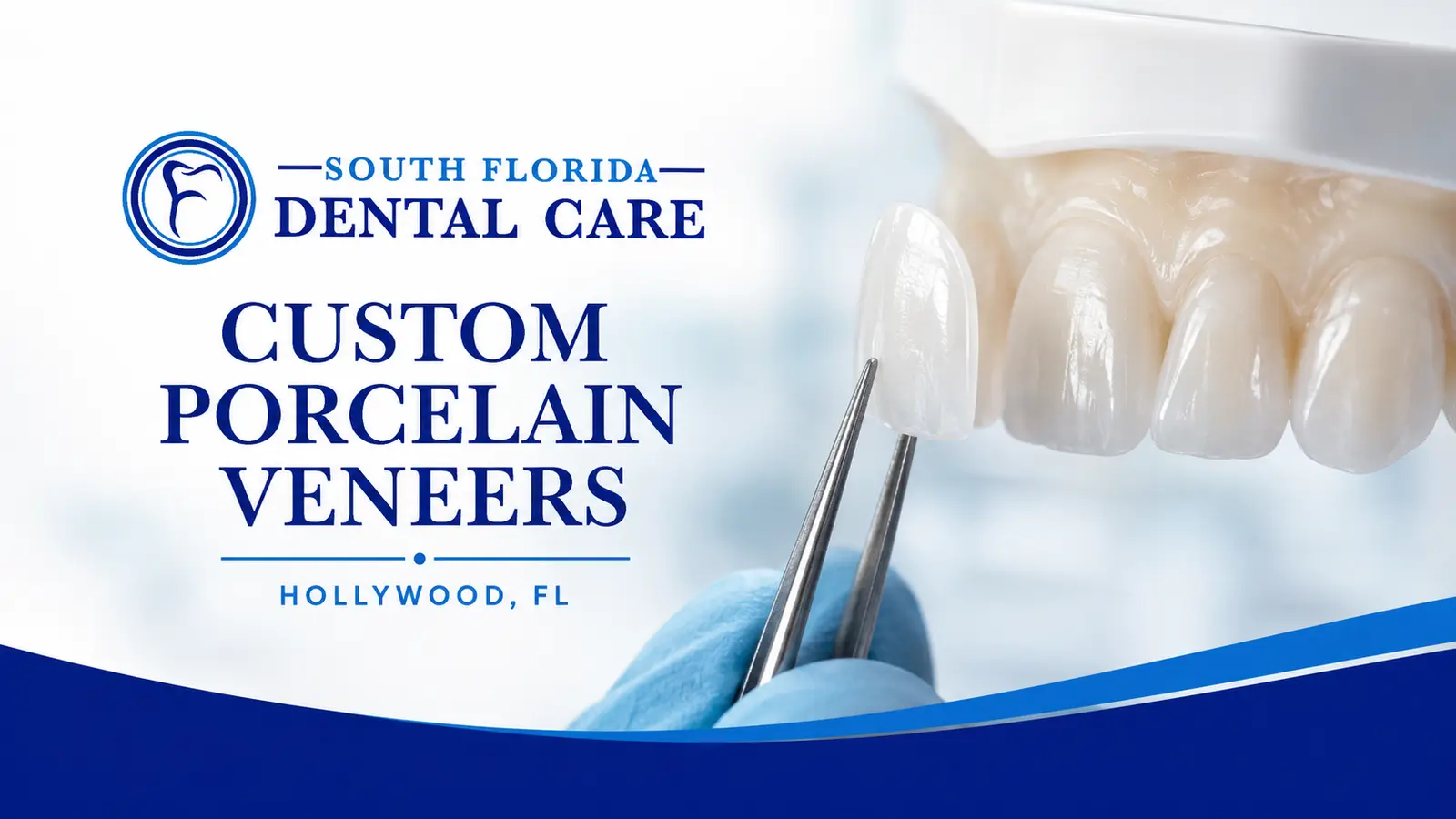
At South Florida Dental Care, veneer treatment is planned around your facial features, natural teeth, gumline, bite, and individual cosmetic goals. We provide porcelain veneers for patients in Hollywood, Pembroke Pines, Hallandale Beach, Aventura, and surrounding communities.
Call (954) 966-6410 or request a consultation to find out whether porcelain veneers are appropriate for your smile.
A porcelain veneer covers the front surface and selected edges of a tooth. Unlike a dental crown, which surrounds a tooth more extensively, a veneer is primarily used to change the appearance of a visible tooth.
Each veneer is designed to match the treated tooth and the surrounding smile. Its shape, contour, shade, surface texture, and translucency can be customized to complement neighboring teeth rather than creating an identical appearance for every patient.
Porcelain generally resists staining better than composite resin, but veneers are not maintenance-free or guaranteed to last indefinitely. The natural teeth and gums beneath and around them remain important to their long-term stability.
Veneers may be considered for concerns involving:
A veneer changes the visible surface of a tooth. It does not move the tooth or correct the underlying position of its root. Veneers may camouflage selected minor alignment concerns, but they are not a substitute for orthodontic treatment when tooth movement, bite correction, or significant crowding needs to be addressed.
Veneers are cosmetic restorations rather than a solution for every dental condition. They may not be appropriate for teeth with:
A substantially weakened tooth may require a custom dental crown rather than a veneer. Decay, gum inflammation, infection, and other active conditions should be treated before elective cosmetic care begins.
Porcelain veneer treatment usually requires removing some natural enamel to create space for the restoration and establish an appropriate bonding surface. The amount varies according to the tooth, veneer design, existing alignment, color, and intended result.
Because natural tooth structure is altered, veneer treatment should generally be considered irreversible. Treated teeth will likely continue to require veneers or another restoration in the future.
Claims that every veneer can be placed without tooth preparation should be approached with caution. Minimal-preparation or no-preparation treatment may be possible in selected circumstances, but it is not appropriate for every tooth or every cosmetic goal.
Veneer candidacy is based on more than whether you want a whiter or more uniform smile. Your dentist will evaluate:
Healthy gums are especially important because inflammation or recession can change the appearance of the veneer margins. Learn more about establishing and maintaining good periodontal health.
A successful veneer plan is not simply a matter of selecting the whitest shade. Teeth that look natural vary in translucency, surface texture, shape, proportion, and the way they reflect light.
Planning may include:
The goal is not to make every tooth identical. Veneers should complement the patient’s face, smile, and remaining natural teeth while creating a balanced result.
The treatment process varies depending on the number of teeth involved, the extent of preparation required, the condition of the natural teeth, and how the veneers are fabricated.
Your dentist examines your teeth and discusses the changes you would like to make. Suitable alternatives, limitations, expected maintenance, and the effect on natural tooth structure should be reviewed before treatment begins.
When preparation is required, a controlled amount of enamel is removed to create space for the veneer and an appropriate restoration contour. A local anesthetic may be used depending on the extent of preparation and individual sensitivity.
Impressions or digital records are taken for the custom restorations. Temporary veneers may be placed while the definitive restorations are being completed.
Temporary veneers allow the patient and dentist to evaluate the general shape, length, and appearance, but they do not have the same strength, surface finish, or optical characteristics as the final porcelain restorations.
Before final bonding, the veneers are evaluated for fit, shape, color, proportion, and relationship to the surrounding teeth and gums. The bite is also checked.
The teeth and veneers are then prepared using an adhesive bonding process. After placement, excess bonding material is removed, the margins are refined, and the bite is evaluated again.
Cosmetic dental bonding and porcelain veneers can address some of the same concerns, but they involve different materials and treatment commitments.
Bonding uses tooth-colored composite resin placed directly on the tooth. It may require less alteration of natural enamel and is often suitable for small chips, uneven edges, minor spaces, or localized shape changes. Composite can stain, wear, or chip, and may require periodic polishing or repair.
Porcelain veneers are fabricated outside the mouth and provide greater control when changing the color, shape, size, or proportion of several visible teeth. Porcelain generally offers better stain resistance than composite but requires more planning and usually involves permanent alteration of the teeth.
Neither treatment is automatically superior. The more appropriate option depends on the size of the desired change, condition of the teeth, bite forces, available enamel, and long-term expectations.
Professional teeth whitening changes the shade of natural teeth without changing their shape or size. When tooth color is the primary concern, and the teeth are otherwise healthy, whitening may be a more conservative first option.
Veneers may be considered when discoloration does not respond adequately to whitening or when the patient also wants to change tooth shape, length, proportion, or symmetry.
Porcelain does not respond to whitening gel after placement. When whitening and veneers are part of the same cosmetic plan, whitening is generally completed first so the veneers can be matched to the resulting tooth shade.
Veneers primarily improve the visible surfaces of teeth that retain sufficient healthy structure. Crowns cover teeth more extensively and may be recommended when structural protection is a major treatment objective.
A dental crown may be more appropriate for a tooth with extensive decay, a large filling, a significant fracture, substantial wear, or inadequate structure for a veneer.
The decision should be based on the tooth’s clinical condition rather than appearance alone.
A veneer can be placed on one tooth, but matching a single porcelain restoration to several natural neighboring teeth can require careful shade and texture planning.
When multiple veneers are considered, the number should be based on which teeth are visible, which teeth require treatment, and how the restorations will relate to the untreated teeth. Veneers do not automatically need to be placed on every front tooth.
A conservative plan may involve whitening first, then restoring only the teeth that cannot be adequately improved through whitening or bonding.
Porcelain veneers can function for many years, but they should not be described as permanent or guaranteed for life. They may eventually require repair or replacement.
Longevity can be affected by:
Veneers should be brushed and cleaned daily. Although porcelain cannot develop decay, the natural tooth around and beneath a veneer remains susceptible to dental disease.
Regular dental examinations and professional cleanings allow your dentist to evaluate the veneer margins, supporting teeth, gum health, and bite.
Avoid using veneered teeth to bite fingernails, open packages, chew ice, or hold hard objects. Patients who grind or clench may be advised to wear a protective appliance.
The American College of Prosthodontists recommends lifelong professional maintenance for teeth restored with veneers, crowns, bridges, and other restorations.
Contact the dental office if you notice:
These symptoms do not automatically mean the veneer must be replaced, but they should be evaluated before the condition progresses.
Dr. Leonardo Frydman is a prosthodontist with advanced education in restoring and replacing teeth. His training includes treatment involving veneers, crowns, bridges, dental implants, dentures, and comprehensive restorative care.
Dr. Gabriela Cohen has postgraduate education in operative and cosmetic dentistry and provides comprehensive care with a conservative cosmetic approach.
Learn more about prosthodontic treatment or meet the dentists at South Florida Dental Care.
South Florida Dental Care is located at 4030 Sheridan Street, Suite B, in Hollywood, Florida. We welcome patients from Hollywood, Pembroke Pines, Hallandale Beach, Aventura, and nearby communities.
To discuss porcelain veneers or compare them with whitening, bonding, crowns, or another cosmetic dentistry option, call (954) 966-6410 or contact South Florida Dental Care to request a consultation.