For most patients, fluoride is safe and effective when used at recommended levels. It strengthens enamel, helps repair early tooth decay, and makes teeth more resistant to future acid attacks.
That answer still requires context. Fluoride toothpaste, professional fluoride treatments, naturally occurring fluoride, community water fluoridation, and unusually high fluoride exposure are not interchangeable. The amount, source, frequency, and whether you swallow fluoride all matter.
This distinction has become particularly important for patients in Hollywood, Florida. The City of Hollywood stopped adding fluoride to its drinking water on July 1, 2025, following a change in Florida law. Patients who previously received some cavity protection from fluoridated tap water may now need to pay closer attention to their individual prevention plans.
At South Florida Dental Care, our goal is not to dismiss reasonable questions or exaggerate risks. It is to explain what current research shows, where uncertainty remains, and how patients can use fluoride appropriately.
If you are concerned about cavities, enamel weakness, fluoride exposure, or changes to the local water supply, call South Florida Dental Care at (954) 966-6410 or request an appointment online.
What Is Fluoride and How Does It Protect Teeth?
Fluoride is a naturally occurring mineral found in water, soil, rocks, and certain foods and beverages. It is also used in toothpaste, mouth rinses, professional dental treatments, and some prescription products.
Every day, acids produced by oral bacteria and acids in foods and drinks remove minerals from tooth enamel. Saliva helps replace some of those minerals, but repeated acid exposure can weaken the tooth surface.
Fluoride helps by:
- Making enamel more resistant to acid attacks
- Helping replace minerals that have been lost from weakened enamel
- Slowing very early tooth decay before a physical hole forms
- Reducing the ability of certain oral bacteria to contribute to cavities
The National Institute of Dental and Craniofacial Research explains that fluoride can help prevent tooth decay throughout life. Both children and adults may benefit.
Fluoride cannot rebuild tooth structure after a physical hole has developed. However, when decay is identified while the enamel surface remains intact, fluoride may be one part of a plan to stop or reverse the earliest damage. Our article about when cavities require fillings explains this distinction in more detail.
Is Fluoride Safe?
At recommended levels and when used properly, fluoride has a long history of use in cavity prevention. Safety questions can become confusing when studies involving high total exposure are discussed as though they evaluate ordinary toothpaste use or water containing a much lower amount of fluoride.
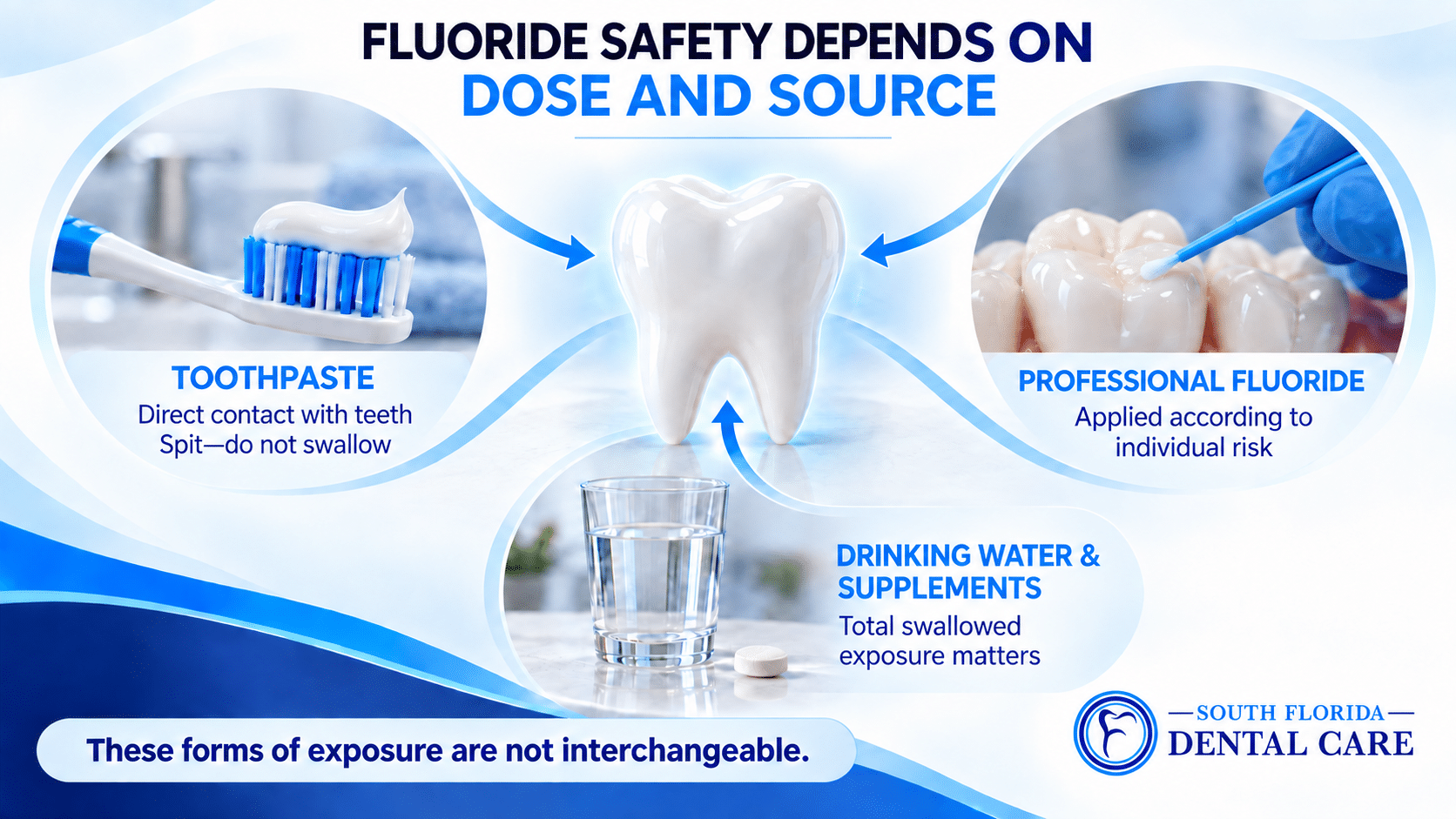
Like many substances, fluoride’s effects depend on the dose. Excessive exposure can cause harm, while controlled exposure directly to the teeth can provide meaningful dental benefits.
It is useful to separate three different questions:
- Is fluoride toothpaste safe when used as directed?
- Is professionally applied fluoride safe?
- What does research say about fluoride swallowed through drinking water or supplements?
The evidence and exposure patterns differ for each source.
What Does the Latest Research Say About Fluoride and IQ?
Recent headlines about fluoride and brain development have caused understandable concern. The findings deserve careful explanation rather than a one-sentence claim that fluoride is either completely harmless or universally dangerous.
The National Toxicology Program Review
In 2024, the National Toxicology Program published a comprehensive review of fluoride exposure, brain development, and thinking ability. It concluded with moderate confidence that higher fluoride exposure—such as drinking water containing more than 1.5 milligrams per liter—was associated with lower IQ in children.
The review did not conclude that community water fluoridation at the former U.S. recommended level of 0.7 milligrams per liter caused lower IQ. The National Toxicology Program stated that insufficient data existed to determine whether that lower level negatively affected children’s IQ.
It also emphasized that:
- The review examined total fluoride exposure from multiple sources, not community water fluoridation alone.
- Most of the supporting studies came from countries where exposure was higher than typical U.S. fluoridation levels.
- An association does not by itself prove that fluoride caused the measured difference.
- The review found no evidence of adverse effects on adult thinking or memory.
You can review the agency’s explanation on the National Toxicology Program website.
Newer Research at U.S. Fluoridation Levels
A 2026 study published in the Proceedings of the National Academy of Sciences examined community water fluoridation, adolescent IQ, and later thinking and memory using information from the Wisconsin Longitudinal Study.
The researchers found no evidence that exposure to community water fluoridation at levels relevant to U.S. policy was associated with lower adolescent IQ or poorer mental performance in adulthood. The study matters because it used a large U.S. population and followed outcomes across much of participants’ lives.
No single study settles every scientific question. However, this research helps address a key limitation of earlier evidence, which involved higher exposures or populations outside the United States. The full 2026 study is available through PNAS.
What Is the Reasonable Conclusion?
Current research supports taking high fluoride exposure seriously. It does not establish that brushing with fluoride toothpaste as directed, receiving professional fluoride treatments, or drinking water at the former U.S. target of 0.7 milligrams per liter causes cognitive harm.
Patients should also recognize that water fluoride concentration and a person’s total exposure are not always the same. Drinking-water source, swallowed toothpaste, tea consumption, supplements, and other sources can all contribute to total exposure.
Does Fluoride Still Help Prevent Cavities?
Yes. Fluoride’s strongest and most direct benefit is strengthening tooth enamel and reducing cavity risk.
A 2024 Cochrane review found that the cavity-prevention benefit of community water fluoridation may be smaller today than it was before fluoride toothpaste became widely available. The contemporary evidence showed a modest possible benefit for children, but the researchers noted uncertainty and limitations in the available studies.
That does not mean fluoride has stopped working. It means people now receive fluoride from additional sources, particularly toothpaste, making the independent effect of fluoridated water harder to measure.
Newer research continues to find dental benefits:
- A 2026 study found that adults with long-term exposure to fluoridated water had less tooth decay and fewer teeth affected by decay.
- A 2026 study evaluating the end of water fluoridation in Israel found that tooth decay increased among children, with larger effects in lower-income communities.
- Fluoride toothpaste and professional fluoride treatments remain established tools for preventing or controlling tooth decay.
Research should continue, but biological evidence, population research, and clinical experience support fluoride’s role in preventing cavities—not simply historical public-health policy.
Hollywood No Longer Adds Fluoride to Its Drinking Water
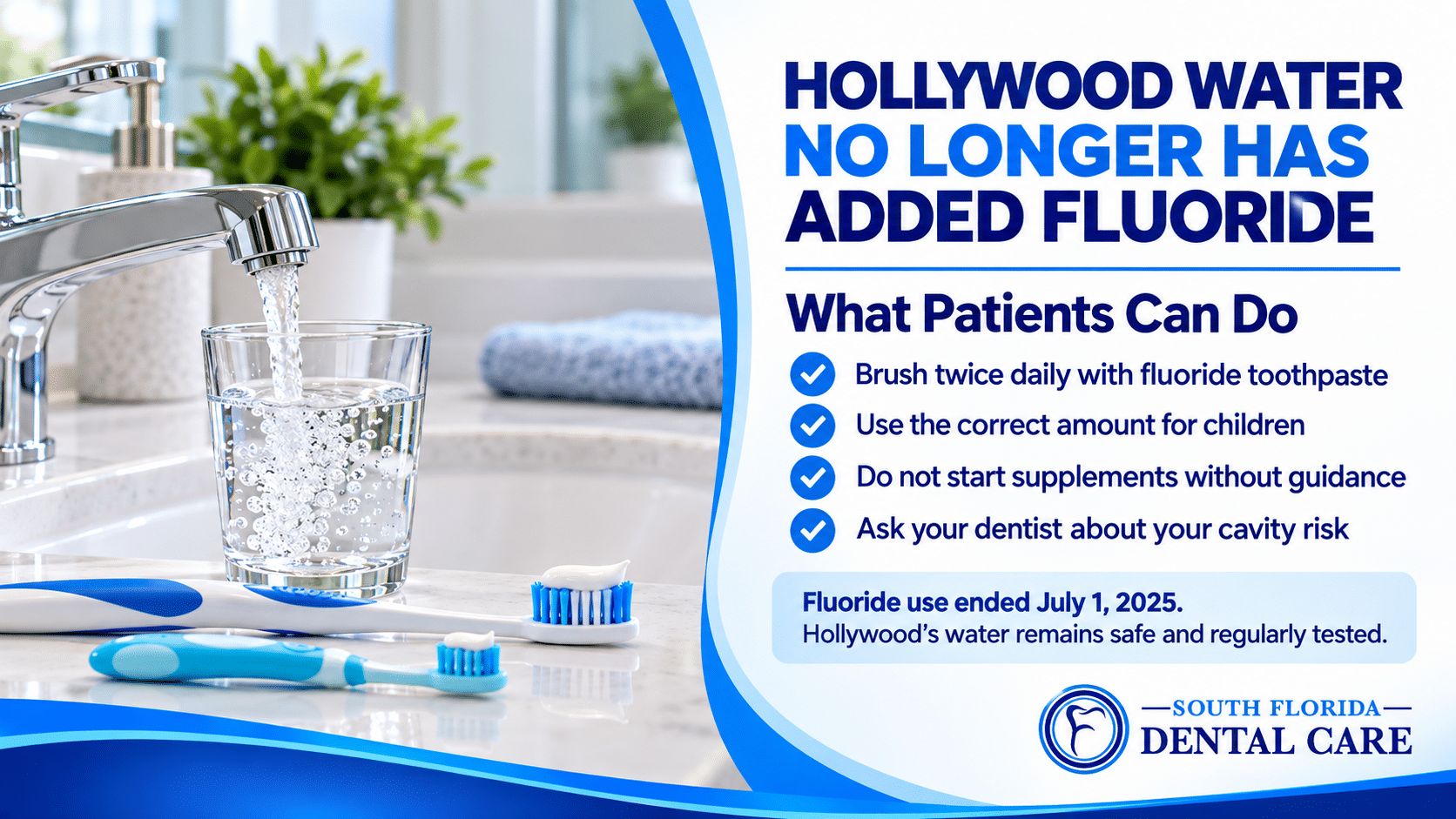
The City of Hollywood reports that it stopped adding fluoride to the public water supply on July 1, 2025. The change was required after Florida prohibited adding fluoride and other health-related additives to public drinking water.
This does not mean Hollywood’s water is unsafe. The city continues to test and manage its drinking water under applicable water-quality standards. It means the water no longer provides the same intentionally adjusted fluoride exposure previously used to prevent cavities.
Naturally occurring trace amounts of fluoride may still be present, and levels can vary. Bottled water also varies considerably and may contain little or no fluoride.
The change does not mean every Hollywood resident automatically needs a supplement or professional fluoride treatment. Cavity risk differs according to:
- Previous and active tooth decay
- Saliva production and dry mouth
- Diet and frequency of sugar or acid exposure
- Exposed tooth roots or gum recession
- Brushing and interdental cleaning habits
- Existing crowns, bridges, fillings, or orthodontic appliances
- Age and ability to perform effective home care
- Medications and medical conditions
A dentist can evaluate these factors before recommending additional fluoride.
Fluoride Toothpaste vs. Fluoridated Water
Fluoridated water and fluoride toothpaste deliver fluoride to teeth differently.
Fluoride Toothpaste
Toothpaste delivers fluoride directly to tooth surfaces during brushing. This contact helps protect enamel and replace some of the minerals lost during the earliest stages of decay. Most patients should brush twice daily with an appropriate fluoride toothpaste unless their dentist recommends otherwise.
Spit out toothpaste rather than swallow it. Young children need supervision and should use only the recommended amount.
Fluoridated Water
Fluoridated water previously provided repeated, low-level exposure throughout the day. It also protected people who might not have consistent access to dental products or professional care.
Because Hollywood no longer adds fluoride to its water, regular use of fluoride toothpaste and individualized preventive dental care may become more important.
Professional Fluoride Treatments
Professional fluoride varnish or gel places a concentrated product directly on the teeth. Providers may recommend it for children or adults with elevated cavity risk, early enamel weakening, exposed roots, dry mouth, orthodontic appliances, or a history of recurrent decay.
Professional treatment is not automatically necessary for every patient. Its value depends on the individual’s risk and current oral condition.
How Much Fluoride Toothpaste Should Children Use?
Children should use fluoride toothpaste in amounts appropriate for their age and ability to spit:
- Younger than age 3: Use a smear no larger than a grain of rice once teeth begin appearing.
- Ages 3 through 6: Use a pea-sized amount.
- Older children: Continue supervising until they can brush thoroughly and reliably spit out the toothpaste.
The American Dental Association’s patient guidance recommends brushing twice daily and supervising young children, so they use the correct amount and do not swallow toothpaste.
Parents should not start fluoride drops, tablets, or other swallowed supplements solely because local water is no longer fluoridated. A dentist or pediatrician should first consider the child’s age, cavity risk, drinking-water source, toothpaste use, and total fluoride exposure.
What Is Dental Fluorosis?
Dental fluorosis is a change in enamel appearance caused by swallowing too much fluoride while permanent teeth are developing beneath the gums. It does not occur from fluoride exposure after the teeth have fully formed.
Mild fluorosis may appear as faint white lines or spots that are difficult to notice. More pronounced changes are less common at recommended exposure levels.
Using the correct amount of toothpaste and supervising young children helps reduce unnecessary swallowing while preserving fluoride’s direct benefits to the teeth.
Who May Benefit From Additional Fluoride Protection?
A dentist may consider additional fluoride treatments or a prescription-strength toothpaste for patients with:
- Frequent or recurrent cavities
- Early areas of weakened enamel
- Dry mouth caused by medication, health conditions, or treatment
- Gum recession and exposed tooth roots
- Difficulty brushing effectively
- Orthodontic appliances
- Multiple crowns, bridges, or large restorations
- A diet involving frequent sugar or acidic drinks
- Reduced access to fluoridated drinking water
Fluoride is only one part of cavity prevention. Regular dental hygiene visits, effective brushing and flossing, adequate saliva, a balanced diet, and early diagnosis remain important.
Practical Steps for Hollywood Patients
Now that fluoride is no longer added to Hollywood’s drinking water, patients can take several reasonable steps:
- Brush twice daily with fluoride toothpaste unless advised otherwise.
- Spit out toothpaste rather than swallowing it.
- Supervise children and use an age-appropriate amount.
- Check labels if you rely primarily on bottled water.
- Do not begin fluoride supplements without professional guidance.
- Ask whether your individual cavity risk supports professional fluoride or prescription toothpaste.
- Maintain regular examinations so early enamel changes can be identified before a physical cavity develops.
The right plan should reflect your actual risk—not fear, political messaging, or a one-size-fits-all recommendation.
Frequently Asked Questions
Is fluoride toothpaste safe to use every day?
For most patients, fluoride toothpaste is safe when used as directed. Brush with an appropriate amount, spit it out, and supervise young children to limit swallowing.
Does Hollywood, Florida, still add fluoride to its water?
No. According to the City of Hollywood, fluoride use ended on July 1, 2025. The city continues to test and manage the water for safety and regulatory compliance.
Does fluoride lower children’s IQ?
The National Toxicology Program found an association between higher fluoride exposure and lower childhood IQ, particularly around drinking-water concentrations above 1.5 milligrams per liter. It found insufficient evidence to determine whether the former U.S.
community-water target of 0.7 milligrams per liter affected IQ. A large 2026 U.S. study found no association between community fluoridation and adolescent IQ or adult thinking and memory.
Should my child take fluoride supplements now that Hollywood water is not fluoridated?
Do not start supplements automatically. A dentist or pediatrician should first consider the child’s age, cavity history, drinking-water source, toothpaste use, diet, and total fluoride exposure.
Can adults benefit from fluoride?
Yes. Fluoride can help adults protect enamel and exposed tooth roots. It may be particularly useful for people with dry mouth, gum recession, frequent cavities, multiple restorations, or difficulty maintaining effective home care.
Can too much fluoride be harmful?
Yes. Excessive fluoride exposure can cause dental fluorosis while teeth are developing, and very high long-term exposure may create additional health concerns. This is why the amount, source, and total exposure matter.
Ask South Florida Dental Care About Your Fluoride Needs
Consider fluoride as part of an individualized prevention plan. Some patients may receive sufficient protection from regular fluoride toothpaste, while others may benefit from professional treatments, prescription toothpaste, or closer monitoring for early decay.
Dr. Leonardo Frydman, Dr. Gabriela Cohen, and the South Florida Dental Care team can evaluate your enamel, cavity history, saliva, restorations, home-care routine, and other risk factors before recommending treatment.
South Florida Dental Care is located at 4030 Sheridan Street, Suite B, Hollywood, FL 33021. We welcome patients from Hollywood, Pembroke Pines, Hallandale Beach, Aventura, and surrounding communities.